

 Free demo at your location
One of the most frequently asked questions is:
“Which screening bucket is the best match for my excavator?”
The answer is not as simple as looking at the machine’s operating weight alone.
The right choice depends on several factors, including the excavator’s own weight, the presence of a tilt coupler or tiltrotator, the hydraulic capacity and the type of work the screening bucket will be used for.
A screening bucket that is too small limits production capacity. A bucket that is too large can overload the excavator, reduce operator comfort and cause unnecessary wear.
In this article, we explain step by step how to make the right choice.
Of course, you are always welcome to contact us for personal advice—we are happy to help.
Step 1. Determine the actual machine weight
When selecting a screening bucket, we always use the operating weight of the base machine. This refers to the excavator’s operating weight without a bucket or any attachments.
This forms the starting point for determining the correct machine class.
Step 2. Take the tilt coupler or tiltrotator into account
A tilt coupler, tiltrotator or integrated gripper offers many advantages on site, but it also affects the available lifting capacity of the excavator.
These attachments add weight and increase the distance between the machine and the screening bucket. As a result, the effective lifting capacity decreases, and in many cases a smaller screening bucket will deliver better performance.
To determine the effective machine class, we use the following guidelines:
- Tilt coupler: subtract 10% from the weight of the base machine.
- Tiltrotator: subtract 15% from the weight of the base machine.
- Tiltrotator with integrated gripper: subtract 20% from the weight of the base machine.
Example
An 18-ton excavator:
- with a tilt coupler → 16.2 tonnes;
- with a tiltrotator → 15.3 tonnes;
- with a tiltrotator and gripper → 14.4 tonnes.
Based on this effective machine class, we determine the largest screening bucket that can be used safely and responsibly.
These percentages are a reliable guideline for standard machines. If a machine is equipped with additional counterweights, a modified boom or other technical modifications, these are naturally taken into account in our advice. Ultimately, we always assess the complete machine and its available lifting capacity.
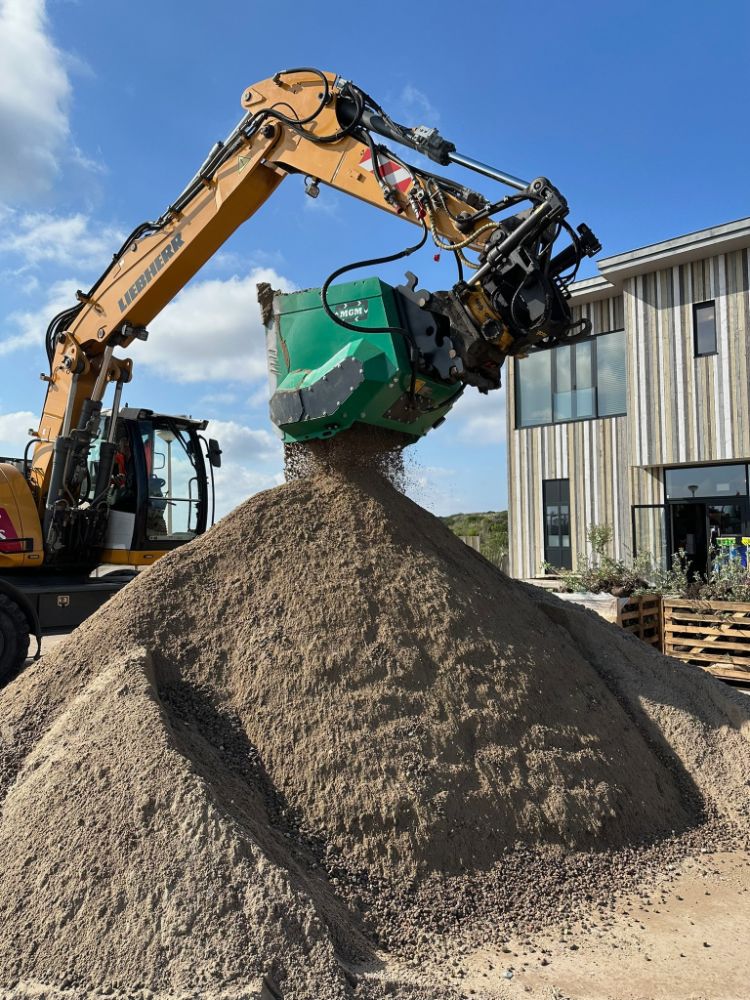
Step 3. Consider the hydraulic capacity
The machine’s weight is not the only important factor.
The hydraulic system also determines how well a screening bucket will perform.
Always check:
- oil flow (l/min);
- maximum operating pressure;
- the machine’s hydraulic settings.
A larger excavator does not automatically deliver better performance if the hydraulic system lacks sufficient capacity.
Step 4. Good advice involves more than machine weight alone
Determining the correct machine class is the first step, but certainly not the only one. At MGM Power, we look beyond the excavator’s specifications.
Our goal is not to sell the biggest or heaviest screening bucket, but to recommend the largest possible screening bucket with which your excavator can operate safely, efficiently and with maximum stability.
A well-balanced combination ensures that the excavator’s full capacity is utilized without unnecessarily compromising lifting capacity, stability or machine lifespan. This results in maximum production per hour and the lowest possible cost per screened cubic metre.
That is why we evaluate more than just machine weight. We also consider:
- the hydraulic capacity;
- the type of application;
- the desired end product;
- the presence of additional attachments.
Excavators with a long-reach boom
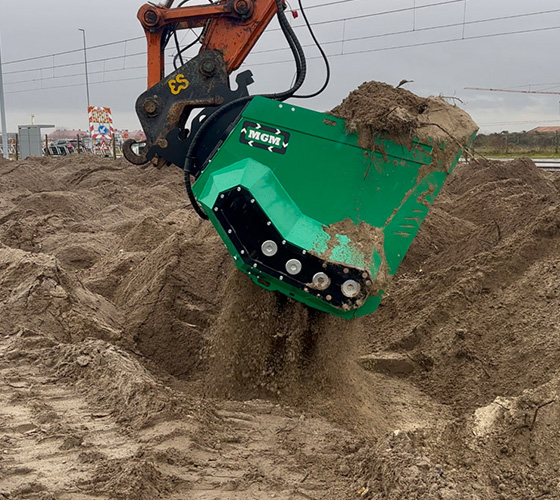
Selecting the correct screening bucket for excavators equipped with a long-reach boom requires a tailored approach.
Because the longer boom reduces the available lifting capacity, the load characteristics vary considerably depending on the manufacturer, boom design and machine configuration. As a result, the standard machine class does not always provide an accurate indication of what is possible.
For this reason, we always determine the best solution together with the customer.
Rather than relying solely on machine weight, we assess the excavator’s lifting capacity at the positions where the screening bucket is actually used. In particular, we evaluate:
- the lifting capacity at maximum reach;
- the lifting capacity when the boom is positioned approximately 2 to 4 metres from the machine.
These are the working positions in which a screening bucket is used most frequently. Based on these values, we determine which screening bucket provides the highest productivity without unnecessarily overloading the excavator.
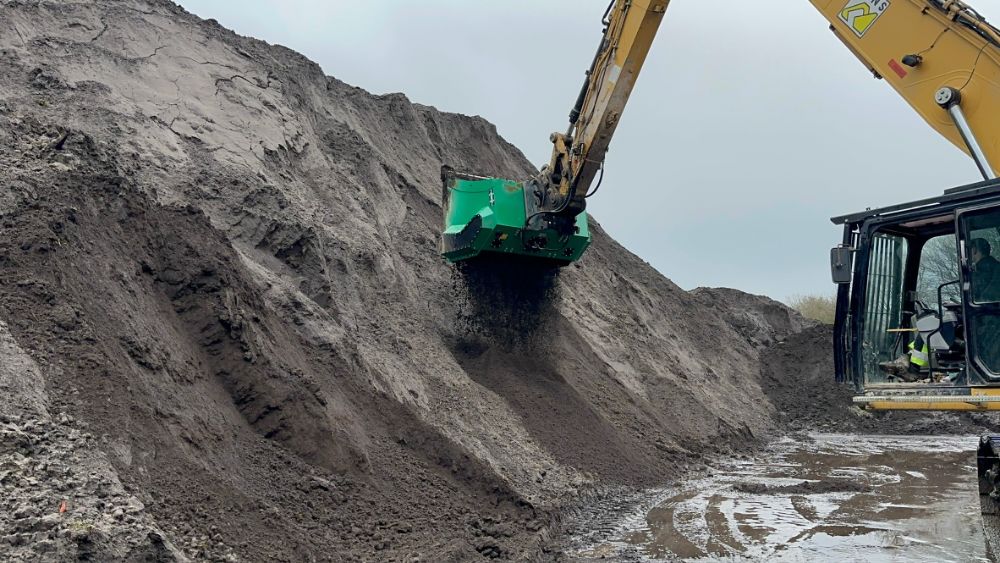
The right size is not always the biggest size
Many users assume that a larger screening bucket automatically delivers higher productivity.
In practice, this is often not the case.
A properly matched screening bucket frequently produces more than one that is simply too large. The right combination provides:
- maximum productivity;
- optimal stability;
- reduced wear;
- a longer service life for both the excavator and the screening bucket;
- greater operator comfort.
Conclusion
Choosing the right screening bucket starts with the machine it will be mounted on, not with the bucket’s capacity.
By considering the weight of the base machine, the effect of attachments, the hydraulic capacity and the intended application, a realistic assessment can be made of your excavator’s capabilities.
At MGM Power, we look beyond simple machine weight classifications. Our goal is always the same: to recommend the largest possible screening bucket that allows your excavator to work safely, efficiently and at maximum productivity.
Every machine is different. That is why we assess every machine-and-bucket combination individually, ensuring an investment that continues to deliver capacity, reliability and low operating costs for many years.

 +31 418 584163
 info@mgmpower.nl
 +31418584163